
I am going to start where the Neprock Wardrobe Closet review section on Amazon does not. Not with the star rating, not with how nice it looks assembled in the listing photos. I want to start with the moment you open the box, because that is where most of the real information about this product lives, and it is information you need before you commit to a spot on your floor.
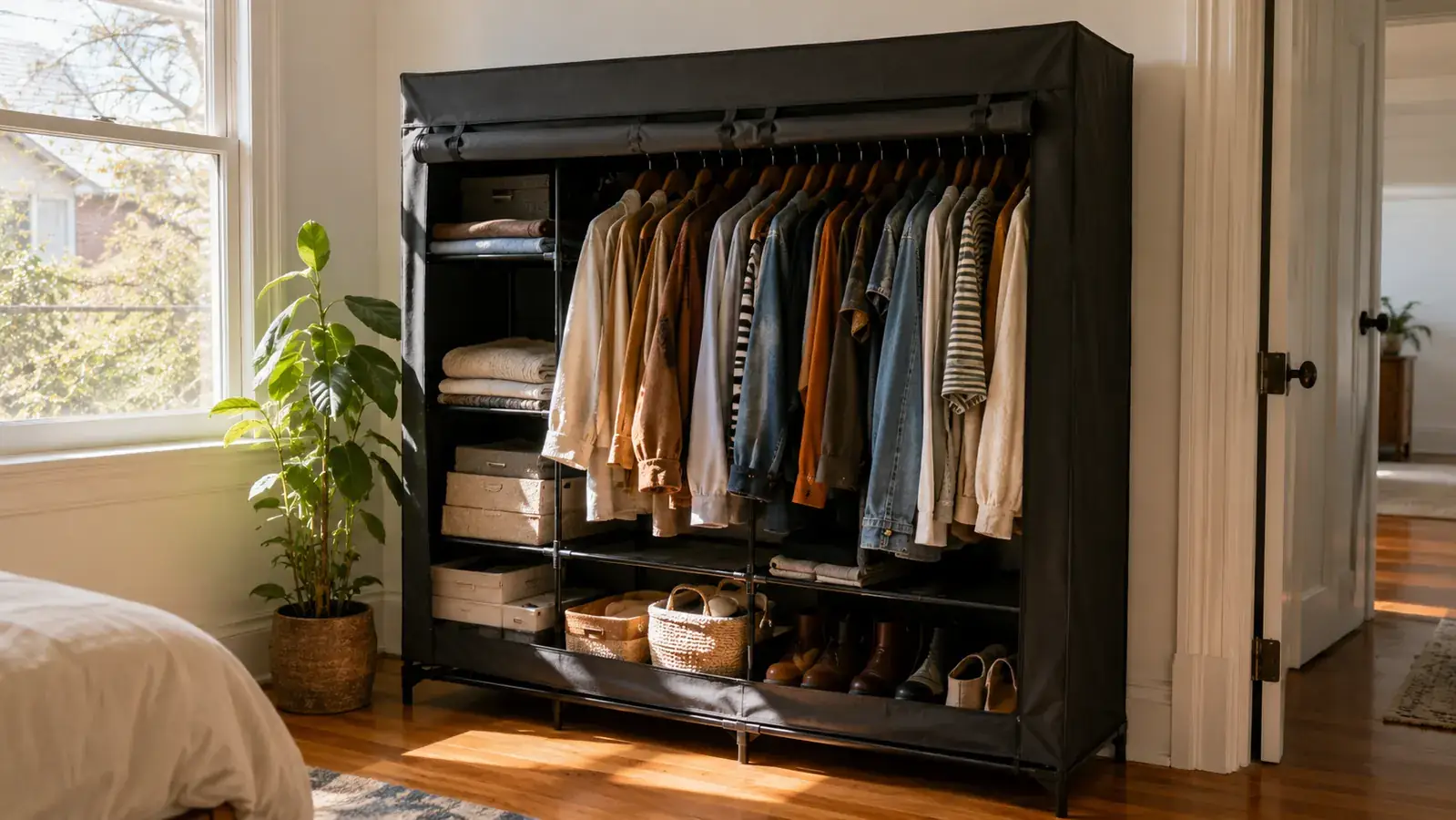
The Neprock portable wardrobe is a fabric-cover freestanding closet with a steel tube frame, a single hang rod, and a bottom shelf. It runs at a budget price point and it has the 4.3-star rating and roughly 2,000 reviews to back up that it works for most people who buy it. But 'works' is doing a lot of lifting in that sentence. Here is the more specific version of what 'works' actually means in a real rental apartment, including the things you figure out by accident rather than by reading the box.
The Quick Verdict
A functional budget freestanding wardrobe for renters with light to medium loads, but there are three assembly steps nobody warns you about and a fabric quirk that will bug you forever if you don't address it on day one.
Amazon Check Today's Price →No built-in closet in your rental? The Neprock costs less than a month at a storage unit.
If you have a closet-free room and a limited budget, the Neprock is worth a serious look. Check Amazon for the current price before you compare alternatives.
Amazon Check Today's Price on Amazon →How I've Used It (The Setup That Reveals Everything)
I put the Neprock in a 9 by 10 foot bedroom that came with no closet at all. The floor is engineered hardwood, flat and level. I wanted it against the long wall, which meant the 63-inch wide unit would leave me about 14 inches of clearance on each side. That clearance turned out to matter more than I expected, because accessing the sides of the unit to tuck the cover correctly requires room to work.
I use it to hold a rotation of 20 to 25 garments: mostly shirts, two pairs of trousers, one blazer, and a light jacket. I am not pushing this thing anywhere near its stated limits. That is a deliberate choice based on what I observed during assembly and early use, which I will walk through in detail below.
The cover zips from bottom to top on the front panel. The bottom shelf sits about 8 inches off the floor, which clears standard shoes. I keep two pairs of sneakers down there and a small flat bin with belts and accessories. Nothing about that is unusual. What is unusual, and what I want you to know before assembly day, starts with the connector joints.
Assembly: The Three Things Nobody Warns You About
The instructions in the box are a single folded sheet with numbered diagrams and almost no text. For a frame this simple, that is mostly fine. But there are three specific things that are not in those diagrams and that will slow you down or create a subtle problem if you get them wrong.
First: the corner connectors are not all identical. If you dump them in a pile and grab them at random, you will end up forcing a piece that does not want to go. The connectors are color-coded or subtly shaped to indicate position, but the instruction sheet does not call this out clearly. Lay them out before you start and match each connector to its position in the diagram. This sounds obvious but I did not do it and I spent ten minutes wondering why one joint would not seat fully. It was the wrong connector for that corner.
Second: the hang rod needs to be seated before you close the top frame. This seems obvious once you know it, but if you assemble the full top frame first and then try to drop the hang rod in, you will find there is not enough flex in the assembled frame to get it in cleanly. The correct sequence is: build the side frames, seat both ends of the hang rod in its support brackets, then close the top cross-member. Working against that sequence is how you end up with a hang rod that feels slightly loose or sits off-center.
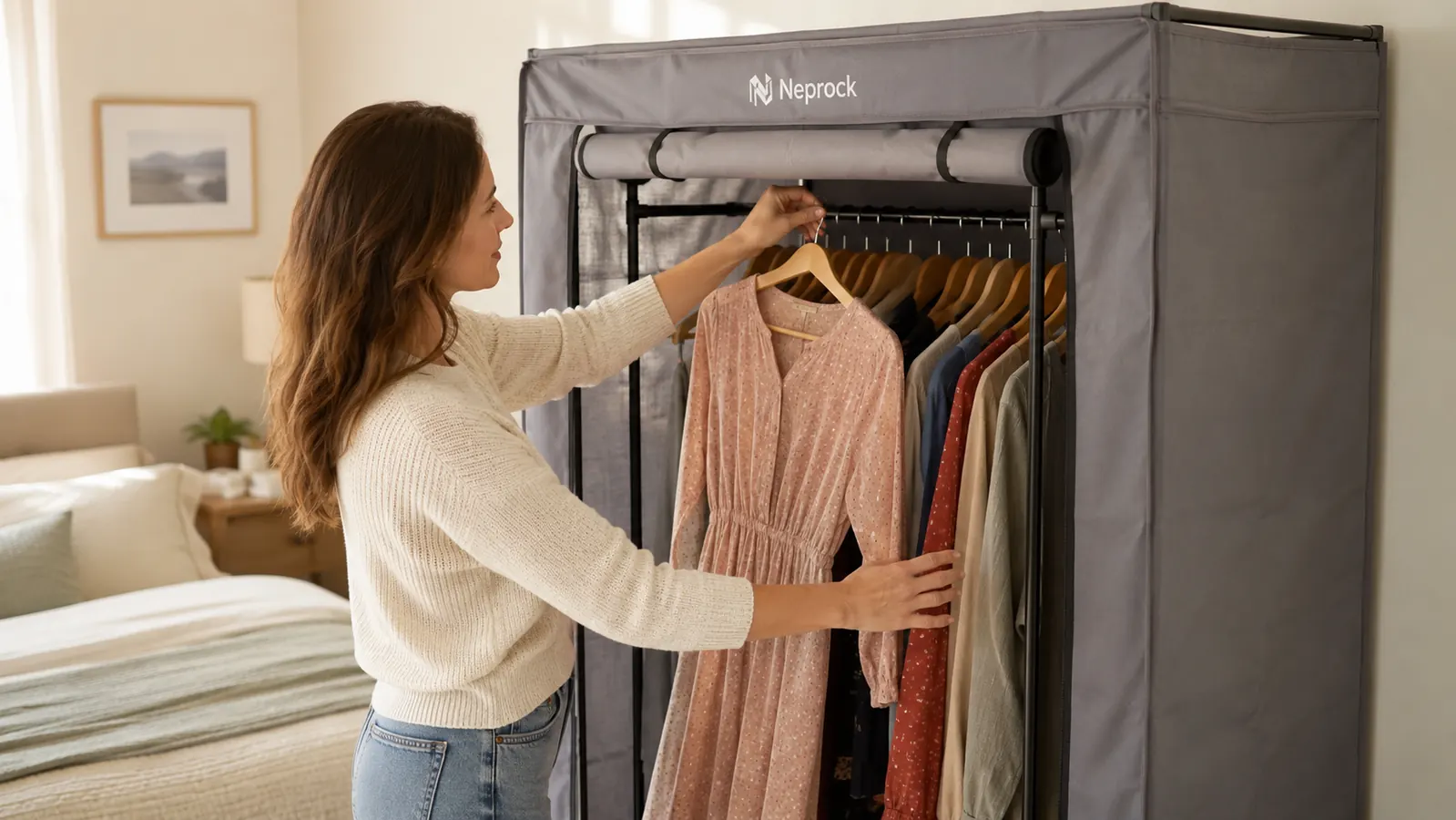
Third: the fabric cover has an orientation that is not marked. The front panel with the zipper and the mesh window goes on the front. That sounds obvious. What is not obvious is which side of the cover is the top. If you pull it on upside down, the zipper will start at the top and open downward, which is technically still functional but weird to use daily and awkward to close fully. Look for the seam placement at the bottom hem before you slide the cover on. The bottom hem has a wider finished edge than the top. Get that right before you start pulling it over the frame.
The Fabric Cover: What Nobody Mentions in the Reviews
The cover is nonwoven polypropylene. This material is everywhere on budget wardrobe closets. It does the job it is supposed to do: keeps dust off, looks tidy from across a room, and does not absorb odors in a meaningful way. But there are two characteristics of this specific cover that the Amazon listing photos will not tell you.
The seams on the cover are stitched, not heat-sealed. Stitched seams on nonwoven polypropylene are fine structurally, but they do not lie flat the way heat-sealed seams do. On the two side panels, the seams form a slight ridge that catches light in certain room lighting and makes the unit look a little cheap up close. From normal room distance it is invisible. If you are putting this in a bedroom and care what it looks like from two feet away, it is worth knowing. The SONGMICS covers I have handled use the same material but with tighter stitch spacing that flattens better.
The zipper on the front panel only opens in one direction: bottom to top. There is no secondary zipper pull that lets you open from the top down. That means if you have shorter garments or accessories stored at the bottom of the hanging space, you open the entire front panel to get to them, not just the bottom section. A dual-direction zipper would solve this. The Neprock does not have one. It is a small thing until it is not.
One more fabric note: the mesh window on the front panel is attached at the corners with small snap fasteners. After a few months, one of my snaps was partially unpopped on the bottom left corner. It snaps back in easily. But it means the mesh panel can bow slightly inward if you do not check those corners periodically.
The cover looks clean from the doorway. Get close and the stitched seams show. If your bedroom is a showroom, that matters. If it is just storage, it does not.
Hangers: The Choice That Changes How the Frame Behaves
The Neprock's hang rod is a single steel tube that spans the full interior width. On a premium wardrobe, that rod would be thicker-gauge steel braced at the center. On the Neprock, it is a thinner tube supported only at its two endpoints. What you hang on it, and more specifically what kind of hangers you use, affects not just whether the rod sags but whether it twists.
Chunky plastic hangers, the wide-shoulder molded kind that come with dry-cleaned suits, distribute their weight over a broad contact point with the rod. Multiply that by a full load of garments and the rod experiences significant rotational stress, not just downward force. Under a full load of thick plastic hangers, the rod can develop a slight longitudinal twist that pushes your clothes toward one end. I noticed this first with bulkier hangers and it resolved when I switched to slim velvet hangers for most of the load.
Slim velvet hangers are the right pairing for this rod. They keep garments from sliding, they reduce the contact footprint per hanger, and the narrower profile lets you fit more garments without the lateral crowding that comes with chunky plastic. If you are buying this closet and do not already own velvet hangers, factor that into your budget. A set of 50 runs inexpensively and the difference in how the rod performs is not subtle.
Floors, Feet, and the Sliding Problem
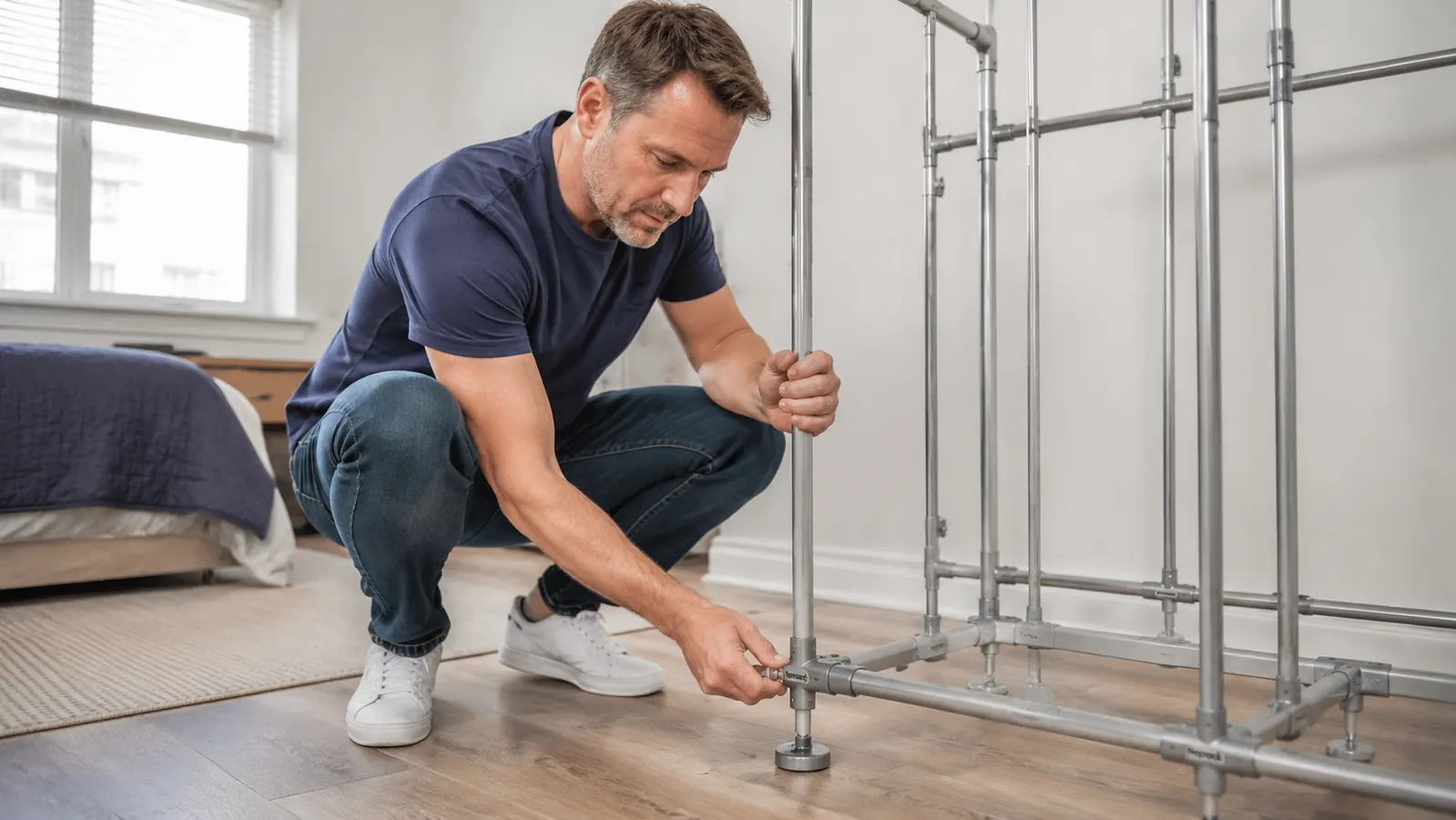
The Neprock has four feet, one at each corner of the frame. On carpet, those feet dig in slightly and the unit stays exactly where you put it. On hard floors, tile, engineered wood, vinyl plank, those feet are smooth plastic against a smooth surface and the unit will migrate. Not overnight, not visibly in real time, but over weeks you will notice it has moved a few inches away from the wall.
The fix is simple and cheap. Adhesive non-slip furniture pads, the small rubber-foam squares sold in packs at every hardware store, placed under all four feet solve this completely. The foot profile on the Neprock is a flat plastic disc about an inch in diameter, so a standard small furniture pad fits cleanly. Do this before you load the unit. Sliding it around fully loaded is awkward and puts lateral stress on the joints.
On uneven floors, which in rental apartments can mean a floor that looks level but has a 2 to 3 millimeter variance across six feet, the unit will have a slight rock. Not a wobble you feel when using it, but a wobble you see if you push gently at a top corner. On truly uneven floors, one foot will not make full contact and the unit will flex slightly when loaded. I have seen this in two different apartments. The fix is a thin felt pad under the short foot to level it out. This is the same approach you use with wobbly furniture anywhere. It works.
Edge Cases the Listing Does Not Mention
This wardrobe is marketed as an all-purpose freestanding closet. Here are some specific scenarios where it works better or worse than you might expect, based on real use rather than the product description.
Kids' clothing: the hang rod height is fixed at around 62 inches from the floor, which is adult-scale. For a child's room where you want a low rod so kids can reach their own clothes, this is the wrong unit. The rod is not adjustable. If you need a dual-level rod or a lower single rod for small kids, look at a unit specifically designed with adjustable rod heights.
Ceiling fan airflow: if your bedroom has a ceiling fan directly above where you plan to place this unit, the cover will move slightly under the airflow. Not dramatically, but enough that the front panel mesh presses in and out gently. It is not damaging, but it is visually noticeable from across the room. If that will bother you, place the unit away from the direct fan zone or orient it perpendicular to the fan's draft direction.
Top surface storage: the top of the frame is not a shelf and the listing does not claim it is. But the top frame cross-members form a fairly stable surface for flat, lightweight items, a thin storage box or a small decorative basket. The trick is that the cover fabric is the actual top surface, not the steel, so anything you balance there sits on fabric stretched over a rectangular frame. It handles light, flat items fine. Anything over five pounds or with a concentrated point load will feel unstable and risk shifting.
Closet use inside an actual walk-in: if you have a walk-in closet with no built-in rod on one wall and you want to add hanging capacity, the Neprock fits that use case well. The enclosed feel of the fabric cover is not necessary in that context, but the unit is stable, compact in depth (18 inches), and easy to move out if you ever want the space back. Just make sure the walk-in ceiling is at least 68 inches or the top frame will contact the ceiling before the unit stands fully upright.
What I Liked
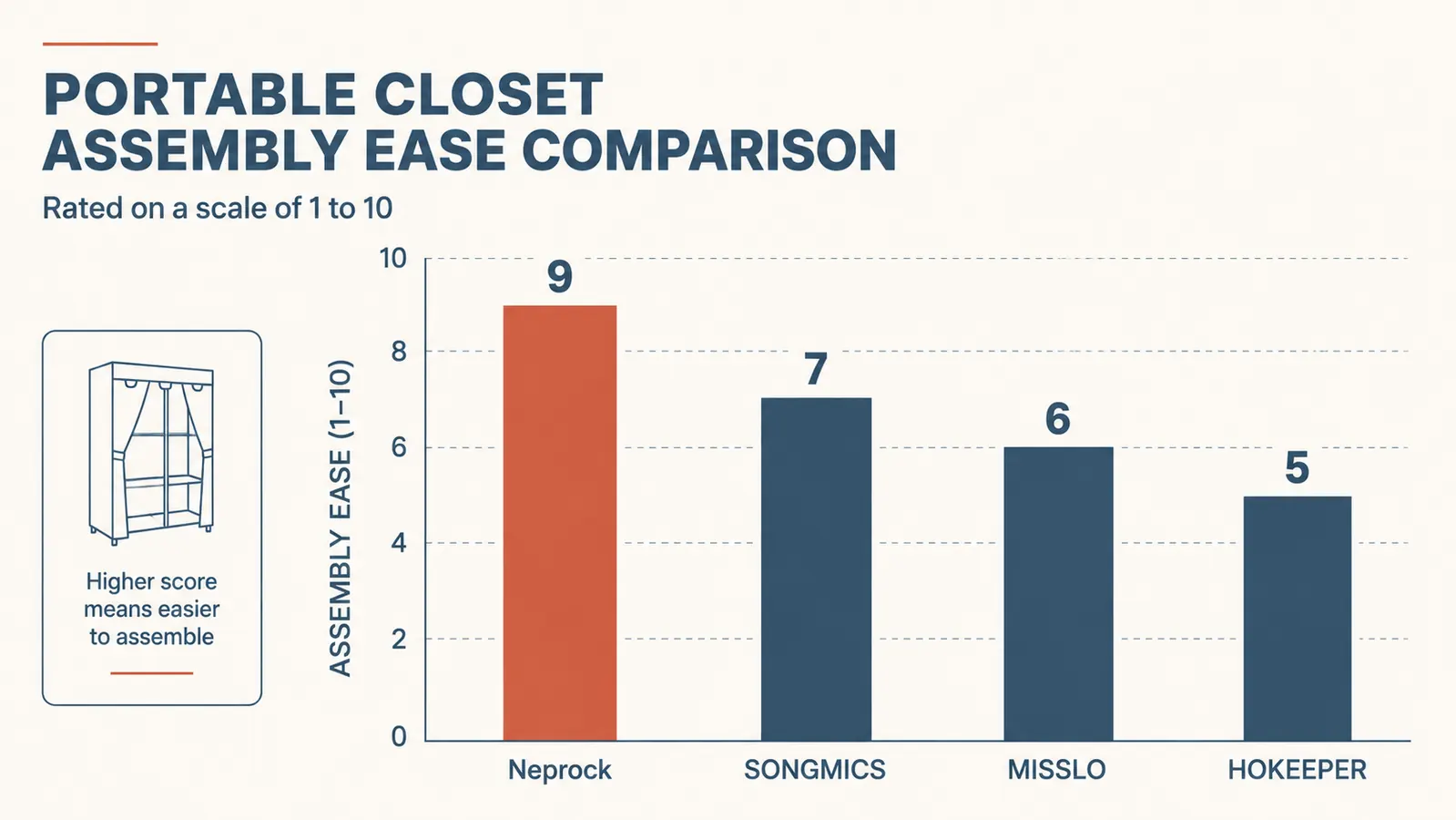
- Assembly is genuinely tool-free once you understand the connector sequence
- 63-inch rod fits a solid rotation of everyday clothes when paired with slim hangers
- Fabric cover keeps dust off and makes a closet-less room look intentional
- Zipper and mesh window hold up to daily use without catching or tearing
- Disassembles flat for moving, no permanent hardware, renter-safe
- Bottom shelf cleared high enough for standard shoe storage underneath
Where It Falls Short
- Assembly instructions do not call out connector orientation or cover top-vs-bottom
- Zipper opens one direction only, no dual-pull for bottom-section access
- Fabric seams stitched not heat-sealed, noticeable up close under direct light
- Mesh window snaps can pop partially with repeated use
- Smooth plastic feet slide on hard floors without non-slip pads added
- No adjustable rod height, wrong unit for kids' rooms or low-ceiling spaces
Who This Is For
The Neprock makes the most sense for renters with a closet-free bedroom or a room where the existing closet is genuinely full and you need overflow storage for lighter everyday clothes. If your load is under 25 pounds on the rod, your floor is hard and flat, and you are willing to spend five minutes on furniture pads before loading it up, this unit will do exactly what you need for a practical price. The aesthetic is functional, not beautiful, but in a room that needed storage it reads as intentional rather than thrown together.
Who Should Skip It
Skip it if you need an adjustable rod, a dual-direction zipper, a built-in upper shelf, or a unit that handles heavy outerwear without visible rod flex. Skip it if you are setting up a kids' room where reach matters. Skip it if the unit will live in a damp basement or an unconditioned garage, the frame coating and fabric both need a stable dry environment to hold up. And skip it if you want something that looks as good up close as it does in the listing photos. It does not quite get there, but for most renters who need functional storage without drilling a single hole, it clears the bar.
If you are comparing it directly against other freestanding options before deciding, the Neprock vs SONGMICS wardrobe comparison walks through the key differences in tube gauge, included shelving, and price gap between the two. And if you are still in the planning stage on how to actually set up a freestanding closet in a rental without making a mess of the room, the step-by-step freestanding closet setup guide covers positioning, loading order, and the non-slip floor fix in detail.
Got a closet-free room and a tight budget? The Neprock is worth checking today.
It is not perfect, but for the use case it is designed for, light everyday clothes in a rental room with no built-in storage, it delivers. Check the current Amazon price before you land on a final decision.
Amazon Check Today's Price on Amazon →